Educational bat trapping & call ID workshops
Practical 3-day field workshops for ecological consultants, students, researchers and anyone else wanting to build confidence in harp trapping, bat retrieval and release, in-hand species identification, echolocation reference call collection, and bat call analysis.
Two workshops are planned for February 2027, each focused on a different NSW bat species assemblage and habitat type, and with slightly different skills covered.
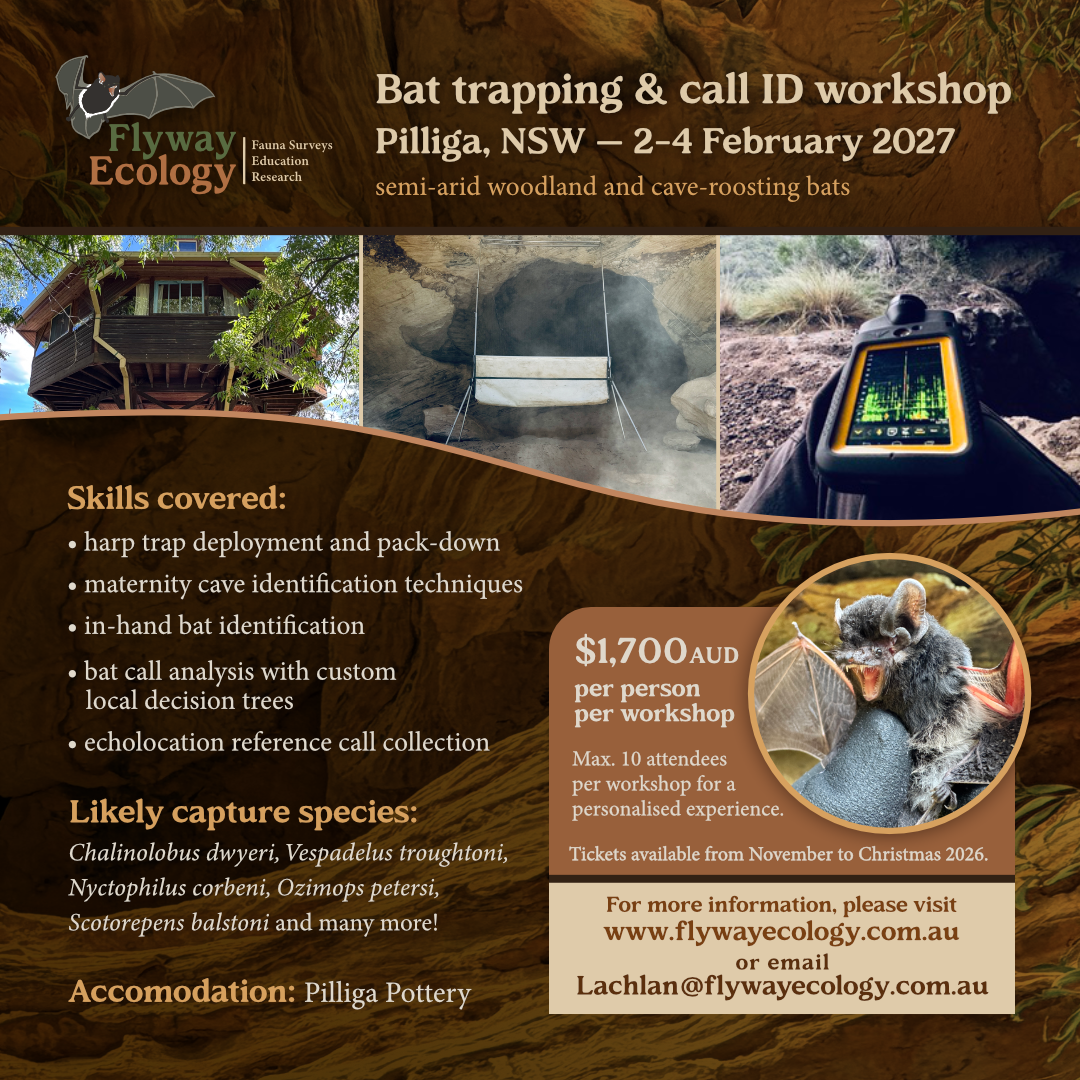
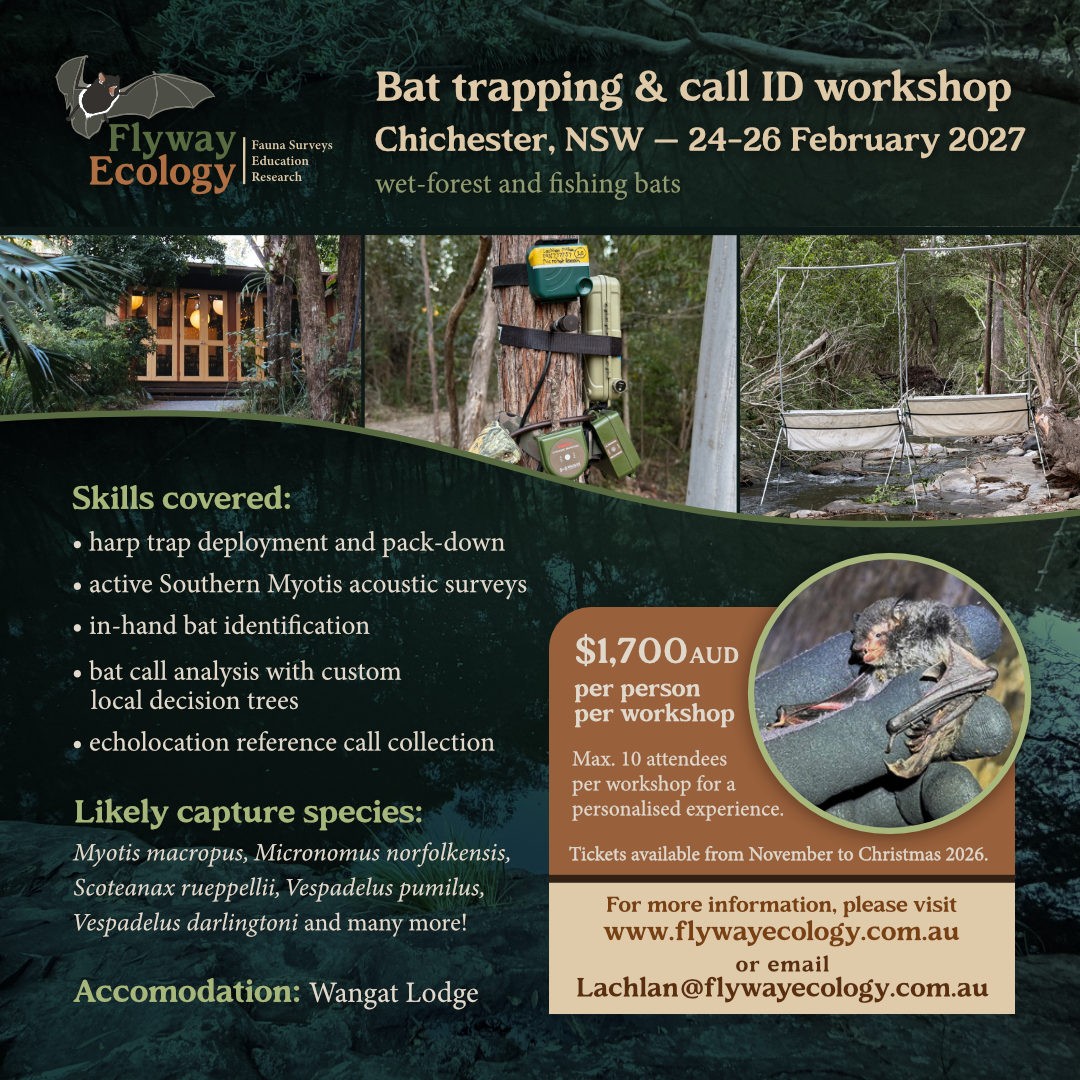
See the workshop flyers below for a quick overview, then scroll down for further details.
Places will be limited to 10 attendees per workshop. Tickets will be available from 1st November 2026 to 24th December 2026 by emailing Lachlan@flywayecology.com.au.
About the workshops
Flyway Ecology is planning two educational bat trapping and call ID workshops in February 2027. The workshops will follow a similar structure and cover many of the same core survey skills, but each will focus on a different habitat type, bat assemblage and set of local identification challenges.
The workshops are primarily field-based and will include two nights of harp trapping, as well as a variety of other outdoor survey activities. During field sessions, the group will be split into smaller sub-groups to provide more direct instruction and a more personalised training experience.
Indoor sessions will be run during the day with the full group of 10 attendees and will focus on in-hand bat identification using external morphology and measurements, and bat call analysis using Anabat Insight and custom local decision trees.
Each workshop will only cover the bat species expected to occur at that specific location. Take-home materials, including the physical workbook, local echolocation reference calls and Anabat Insight decision tree, will therefore be specific to the species covered at that workshop.
Pilliga workshop
2–4 February 2027
The Pilliga workshop will focus on semi-arid woodland and cave-roosting bats.
Unique to this workshop, training will include maternity-roost cave identification and signs of current or historical bat use, including cave-floor guano, urine staining, bat fly pupal cases.
Likely capture species include: Chalinolobus dwyeri, Vespadelus troughtoni, Nyctophilus corbeni, Ozimops petersi, Scotorepens balstoni and many more.
Accommodation will be at Pilliga Pottery.
Chichester workshop
24–26 February 2027
The Chichester workshop will focus on wet-forest and creekline bat assemblages.
Unique to this workshop, training will include targeted active acoustic monitoring techniques for Southern Myotis.
Likely capture species include: Myotis macropus, Micronomus norfolkensis, Scoteanax rueppellii, Vespadelus pumilus, Vespadelus darlingtoni and others.
Accommodation will be at Wangat Lodge.
Skills covered at both workshops
Most core skills covered will be the same at both workshops, but applied to the different local species and habitat type at each site. These skills include:
harp trap deployment and pack-down
bat retrieval and release
in-hand bat identification using morphological features and measurements
recognising age, reproductive condition and key identification features
echolocation reference call collection
ultrasonic detector placement and active acoustic survey methods
bat call analysis using Anabat Insight
use of custom local decision trees for call identification
strengths, limitations and uncertainty in different bat survey methods
What’s Included?
Tickets will be $1,700 per person per workshop and will include:
3 days and 2 nights of practical bat survey and call ID training
comfortable indoor accommodation at the workshop venue
breakfast and dinner during the workshop (bring your own lunch and snacks)
indoor bat call analysis sessions using Anabat Insight
in-hand bat identification demonstrations using external morphology and measurements
echolocation reference calls for the local species covered at that workshop
a physical species identification workbook for the local bat assemblage
a custom local Anabat Insight decision tree for semi-automated call analysis
supporting field and call-analysis resources
A full hour-by-hour workshop schedule will be provided when tickets become available on 1 November 2026 by emailing Lachlan@flywayecology.com.au.
Bat handling and vaccination requirement
Any participant involvement in bat handling or supervised bat release will be limited to attendees who have evidence of appropriate bat lyssavirus/rabies vaccination. Attendees who are not vaccinated can still participate in the workshop, observe in-hand identification demonstrations, participate in field and call-analysis activities, and learn bat retrieval and release procedures through demonstration.
Final handling arrangements will depend on animal ethics, licensing and safety requirements.